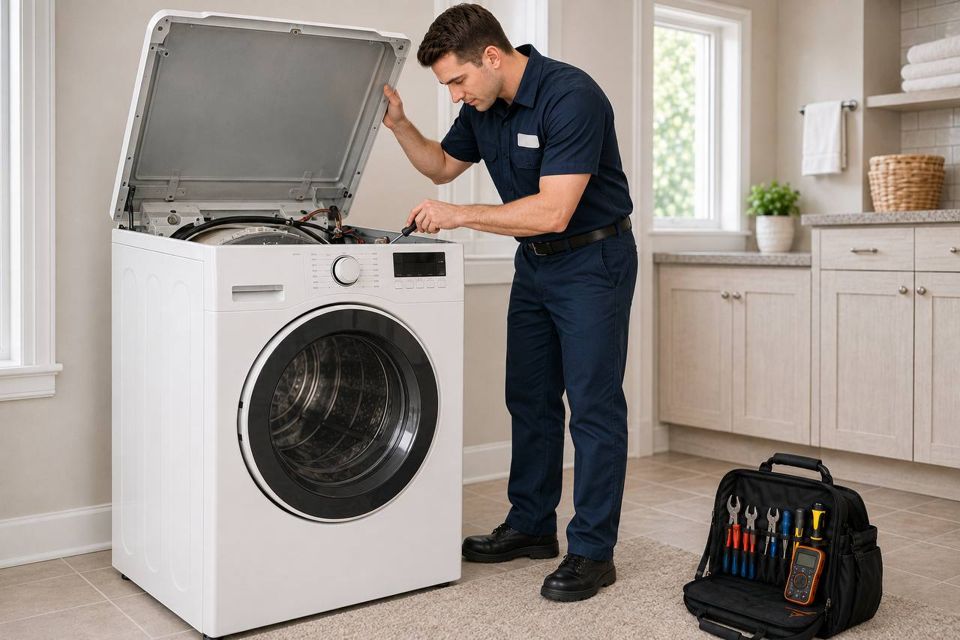
Puddles, new noises, or a cycle that dies at the same minute every load — nearly every washer complaint falls into one of those three bins, and each bin has its own suspects.
Washers in northwest Federal Way fail in patterns the house predicts. Dash Point cottages run their machines on plumbing that was improvised into a former porch or pantry; the Lakota and Adelaide split-levels stack the laundry above a family room, where a shaking spin is felt through the ceiling; Twin Lakes households are replacing the second or third washer to live in the same alcove.
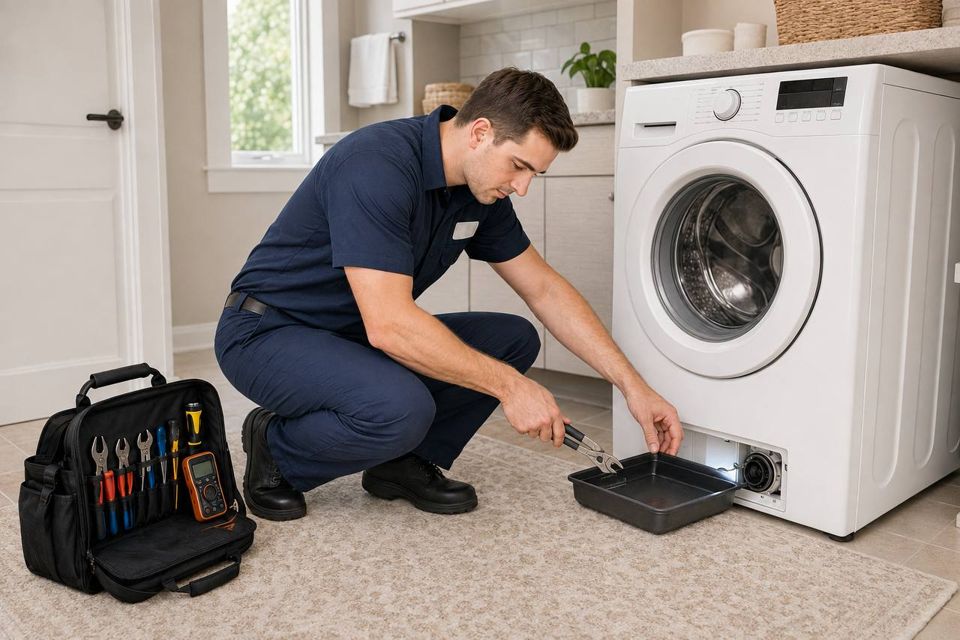
The intake call sorts the complaint into fill, wash, drain or spin, and the sweep tests that stage with the water running. Leaks are traced with the floor dried and a light in hand, because in a cottage laundry room a hose weep, a standpipe overflow and a pump seal all wet the same corner and cost nothing alike.
Washer Repair on the Federal Way leg
Before you book
Stops at the same point every load
Spin loud enough to hear upstairs
Clothes soaked after a finished cycle
Dispenser drawer backing up
Our Twin Lakes wall oven finally died. Remodel? Not yet — most classic widths can be repaired with sourced or adapted parts. The log tells you which parts still turn up before you price a kitchen around a replacement.
The neighborhood’s share
Standpipes, Ceilings, and the Third Washer in the Alcove
Cottage plumbing is the Dash Point signature: drain standpipes cut too short for a modern washer’s pump, so a fast-draining front-loader overflows the pipe and leaves a puddle that looks exactly like a machine leak. The sweep runs a drain cycle with the standpipe watched before anything on the washer is blamed, and when the pipe is the fault the log says so and names the plumbing fix instead of a pump. Salt on the shoreline streets greens the pressure-switch and door-lock spades early, and each gets metered rather than assumed.
In the split-levels a laundry over a living space turns every worn suspension into a household complaint. Owen checks suspension travel, shock rods and the balance ring, then the leveling feet and the floor itself, and puts the machine back on a footing that does not walk. Front-loaders here fail on boots, bearings and door locks; the top-loaders that many Adelaide households still run wear through couplers, lid switches and gearcases, and both are ordinary repairs once the model number is in hand.
Also on this leg. Twin Lakes alcoves were sized for a 1970s top-loader, and the third washer to live there is often a wider modern machine wedged against the wall with its hoses kinked. Part of the sweep there is simply pulling the machine, straightening the supply path and re-leveling — the visit sometimes ends with a small invoice and a machine that has stopped complaining.
Three questions
Washer Repair in Federal Way — Asked Often
Puddle behind the washer in our Dash Point cottage.
A short standpipe overflowing during a fast drain is the first suspect there. A watched drain cycle tells the story before any pump is quoted.
The spin shakes the family room ceiling.
Suspension, balance and footing get checked in that order. On the split-level plan a small suspension repair usually returns the machine to quiet.
Do you carry parts for older top-loaders?
The common couplers, lid switches and pumps ride on the truck. Older platforms are simple, and the log gives a keep-or-retire figure without a sales pitch.
Phone, ZIP, address, machine and the symptom. Owen rings back with a window that holds.
From the keeper’s log
Compartment temperatures, both sides, before opinionsMonitored cycle, fill to drainStacked pairs separated with the right gearCalibrated probe against the control’s beliefDrum hardware replaced as a set