Dryer Repair — Browns Point, Tacoma & the Bay Side
A dryer that runs but does not dry is the most-heard sentence on the intake line, and the honest answer usually lives in the vent rather than the machine. The sweep on a dryer starts at the wall, not the drum.
All makes & agesSame-day slots most weekdaysLog with every visit
Morning loop on the point and in 98023 · scheduled legs to the North End, UP, Gig Harbor and Auburn
Dryer Repair on the bay side — every make, every age
Laundry — heat
How the Sweep Runs
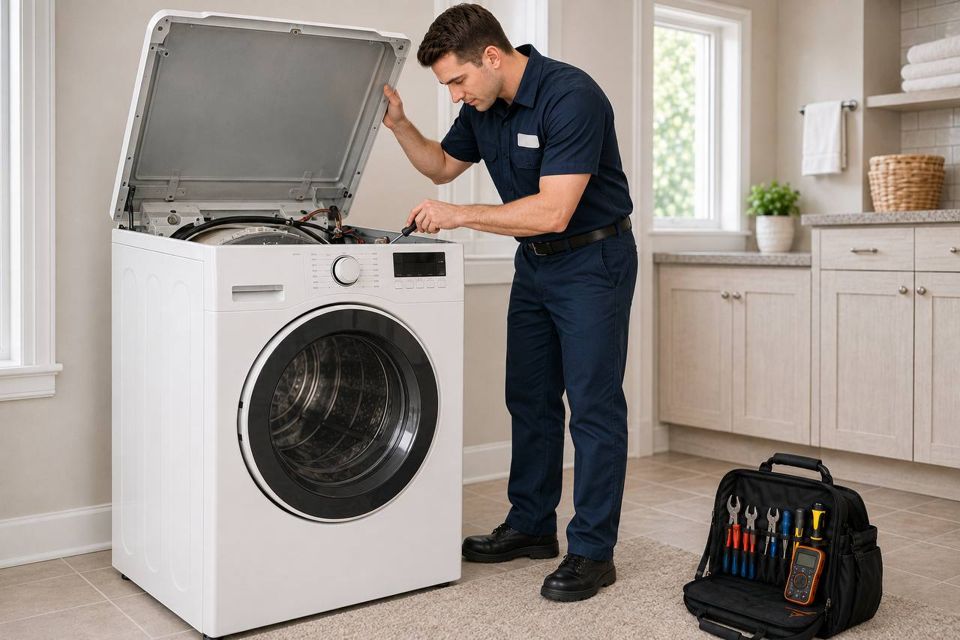
Owen reads static pressure at the transition hose and looks at the exterior termination before touching the panel. Only when airflow is proven healthy do the element, igniter, thermostats and fuse get metered against their ratings — and only the component that misses its number goes onto the figure. A part that passes stays in the machine.
The transition hose is where a dryer sweep begins
Hills, Vents, and the Order of Checks
Northeast Tacoma and the North End are hillside country, and hillside houses route dryer vents the long way — down through framing, under decks, out a wall two rooms away. Long runs lose pressure and hoard lint at every elbow. The sweep measures that loss instead of guessing at it, and the log states when the duct rather than the dryer is behind the slow-dry complaint.
Mechanical noise gets the drum hardware as a set: rollers, idler, glides, belt. They wear together, and replacing the loudest one alone is a repeat visit in disguise. Gas dryers get the full burner chain — igniter draw, coils, flame sensing — with a hard stop at the appliance valve; supply-side faults belong to a plumber and are routed there in writing.
Vent work covers the sections reachable from the machine end and at the exterior hood. A fully buried run is duct-trade work, and the log recommends it instead of fitting a heater the airflow would cook again by spring.
Bring these to the intake call
Full cycle, clothes still damp
Heat drops out mid-load and returns later
Thumping or squealing that tracks drum speed
Thermal fuse gone more than once this year
Scorched smell on high
Gas model glows and clicks but never lights
Book Dryer Repair
Phone, ZIP, address, machine and the symptom. Owen rings back with a window that holds.
Symptom to first check
Where the Sweep Starts
The order is the point: the cheap, likely cause is measured before the expensive, unlikely one is discussed.
What you notice
What the sweep checks first
Damp after a full cycle
Static pressure at the hose, exterior hood
Heat drops out mid-load
Cycling thermostat, airflow, element under load
Thump or squeal with the drum
Rollers, idler, glides, belt — as a set
Thermal fuse repeats
Airflow first; fuse is the symptom
Scorched smell
Lint in the blower housing and element bay
Gas glows, never lights
Igniter draw, coils, flame sensor
Asked on the intake line
Dryer Repair — Asked Often
The dryer takes two runs per load. New element?
Measure first. A healthy element behind a choked hillside vent dries slowly and runs hot. Static pressure at the hose settles it in a minute, and the figure follows the reading.
Do you work on gas dryers?
Yes — igniter, gas coils, flame sensor, the whole chain. Anything upstream of the appliance valve is a plumber’s, and the log says so honestly.
Can the vent itself be fixed on the visit?
The reachable sections, yes — cleared, re-secured, re-verified. A buried house run is a separate trade, and you will hear that plainly rather than get a part you did not need.
Coverage
Dryer Repair by Neighborhood
Each area has its own page, because each area breaks these machines its own way.