Stove & Oven Repair — Browns Point, Tacoma & the Bay Side
A cold-running oven gets blamed on the recipe for a year before anyone measures it. When the roast that used to take ninety minutes now takes a hundred and ten, that is a reading — mention it on the intake call.
All makes & agesSame-day slots most weekdaysLog with every visit
Electric, gas and propane · wall ovens, ranges, cooktops · every area on the map
Stove & Oven Repair on the bay side — every make, every age
Cooking
How the Sweep Runs
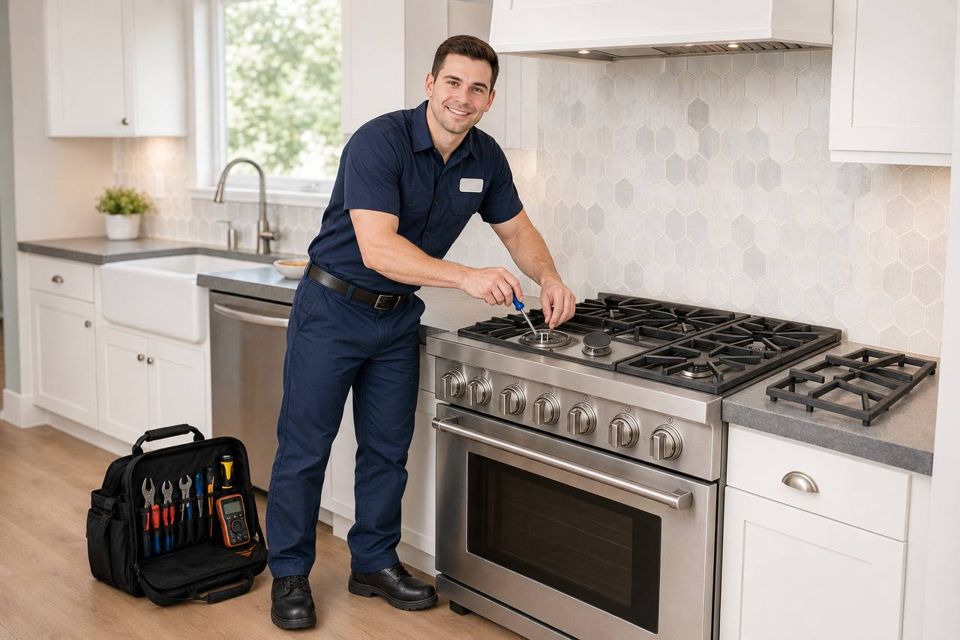
An electric oven gets a certified thermometer hung in the middle of the cavity and left through three heat cycles, then compared with what the display claims; the bake and broil elements and the temperature sensor are metered against the numbers on the service sheet, and the relay board is suspected only when the cavity and the sensor disagree with each other. A gas range gets its igniter amperage read, the valve and orifice inspected and the flame color judged burner by burner. No safety device is ever bypassed on this truck — a jumpered thermal switch is not a repair, and the keeper’s log will never record one.
A probe in the cavity against the control’s belief
Century Kitchens, Propane Kitchens, New Kitchens
The North End’s historic streets still cook on wall ovens and ranges in cutout sizes that vanished from showrooms decades ago. Owen tracks down thermostats, elements and door hardware for those classics through the older parts channels, adapts a modern equivalent where the original is extinct, and says honestly when a control is beyond saving — an original that still works beats a remodel bill every time.
Across the Narrows and along the Federal Way shore, propane is common, and a range delivered with natural-gas jets burns with a lazy yellow flame, blackens the bottoms of pans and takes its time lighting. Converting it — orifices swapped, regulator set for the tank, every burner’s flame checked — takes a single visit and is among the most frequent jobs on the west side of the map.
In the newer kitchens of Northshore and the Uptown condos, the faults are almost always electronic — a sensor drifting, a relay welded, a touch panel that ignores one key — on ranges whose mechanical cores are fine. Those are satisfying repairs: the costly half of the machine is sound, and the figure covers only the half that failed.
Bring these to the intake call
Roasts finish late at the setting that used to work
Broil element dark while bake still works, or vice versa
Igniter ticks without end, or the burner catches with a bang
Glass-top burner will not turn down
Door will not unlock after the clean cycle
Fault code that comes straight back after a reset
Book Stove & Oven Repair
Phone, ZIP, address, machine and the symptom. Owen rings back with a window that holds.
Symptom to first check
Where the Sweep Starts
The order is the point: the cheap, likely cause is measured before the expensive, unlikely one is discussed.
What you notice
What the sweep checks first
Bake runs cold
Calibrated probe, sensor resistance, board relay
Broil dead, bake fine
Element continuity, relay output
Burner clicks forever
Spark module, switch, moisture, orifice
Zone stuck on high
Breaker off first — relay or switch welded
Door locked after self-clean
Lock motor, thermal switch, board
Yellow flame, sooty pans
Fuel type versus orifice — propane conversion
Asked on the intake line
Stove & Oven Repair — Asked Often
Oven runs about 25 degrees cold. Real fix?
Yes — the sensor most of the time, calibration drift some of the time, the board now and then. A thermometer-verified correction beats nudging the dial up, which drifts further every year.
A glass-top burner will not shut off.
Switch the range’s breaker off today — a stuck relay or a fused switch is unsafe to cook around. Once the power is off, the repair itself is routine.
Our 1920s house has a 1970s wall oven. Hope?
Often. Classic-cutout parts still turn up through the older channels or can be adapted, and the log tells you what is available before you price a remodel around a replacement.
Coverage
Ranges and Ovens, Leg by Leg
Century kitchens on the bay leg, propane on the bridge leg, builder packages on the morning loop — the coverage pages say which is yours.