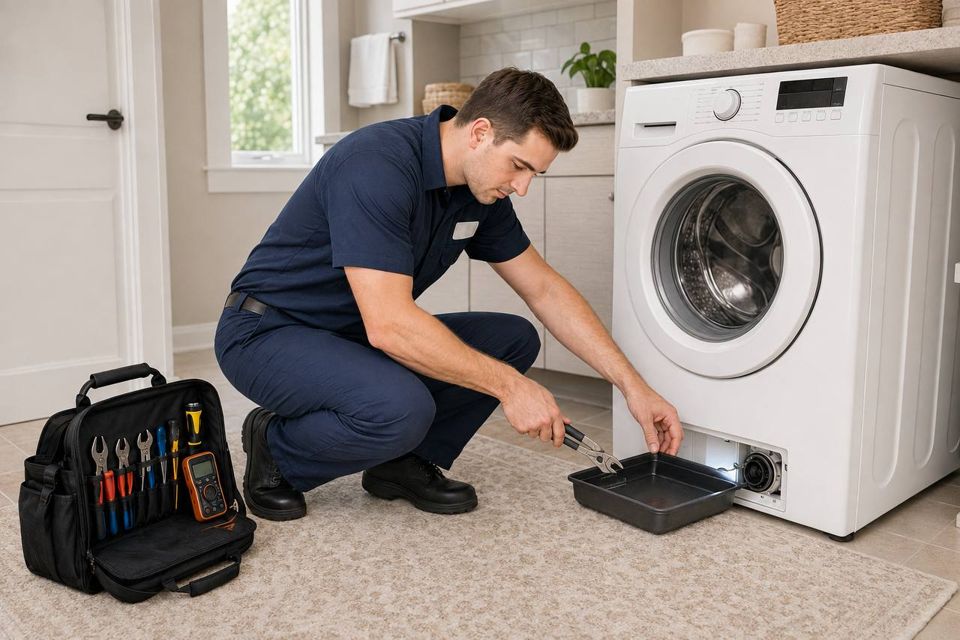
Puddles, new noises, or a cycle that dies at the same minute every load — nearly every washer complaint falls into one of those three bins, and each bin has its own suspects.
A Gig Harbor washer visit is scheduled around the bridge and the commute. 98335 rides a planned leg, and washer calls from Uptown, Olympic Village, the Burnham Drive townhomes, Peacock Hill and Crescent Valley are batched into early and late windows so a working household does not lose a day waiting.
The sweep sorts the complaint into fill, wash, drain or spin and tests that stage with the water running — and on the harbor side the water itself is part of the sweep. City-supplied Uptown washes on one chemistry; the well-fed acreage up the hill washes on another, and the two fail differently enough that the log names which the household is in before any part is quoted.
Washer Repair on the Gig Harbor leg
Symptoms worth mentioning
Spin loud enough to hear upstairs
Clothes soaked after a finished cycle
Dispenser drawer backing up
Lid or door lock refusing to release
Can you work with our HOA or property manager? Regularly. A written log the board can file, a figure that survives a meeting, and visits coordinated with a manager or lockbox when owners are at work.
From the keeper’s log
HOA Fleets and Well-Water Washers
The condo and townhome clusters share stacked laundry pairs from a single builder order, aging in unison. When one unit’s front-loader starts leaking at the boot, the property manager can expect the row to follow, and Owen works with boards and managers on that basis: a lockbox visit, a written log the board can file, and a straight keep-or-retire figure that survives a meeting. Stacked pairs in tight closets are routine — the truck carries the stacking gear to separate and rejoin them without drama.
Peacock Hill and Crescent Valley draw from private wells, and well water leaves iron on inlet screens, scale in the fill valve and grit in the pump that a city-water washer never sees. A washer that fills slowly or floods the dispenser drawer up there is usually a crusted valve rather than a control fault; the sweep pulls and inspects the screens first and meters the valve second. Where the household’s treatment system is the honest culprit, the log says so and recommends a filter change rather than a part.
Also on this leg. The commuter pattern shapes the writing as much as the schedule: the keeper’s log for a harbor washer is written for a household that will read it at nine that night — what was measured, what was replaced, what the machine is worth — so the decision can be made without a second phone call.
Three questions
Washer Repair in Gig Harbor — Asked Often
Can you handle our HOA’s stacked washers as a batch?
Yes. Same builder order, same aging — a manager can book several units on one harbor leg, with a written log per unit the board can file.
Washer on Crescent Valley well water fills slowly.
Iron and scale on the inlet screens and valve, most likely. Screens get cleaned, the valve metered, and the log says whether the treatment system needs a look before the washer does.
We are both at work until six.
Early-morning and late-afternoon harbor windows exist for exactly that, and lockbox access with a phone call on arrival is routine.
Phone, ZIP, address, machine and the symptom. Owen rings back with a window that holds.
Sweeps in progress
Compartment temperatures, both sides, before opinionsMonitored cycle, fill to drainStacked pairs separated with the right gearCalibrated probe against the control’s beliefDrum hardware replaced as a set