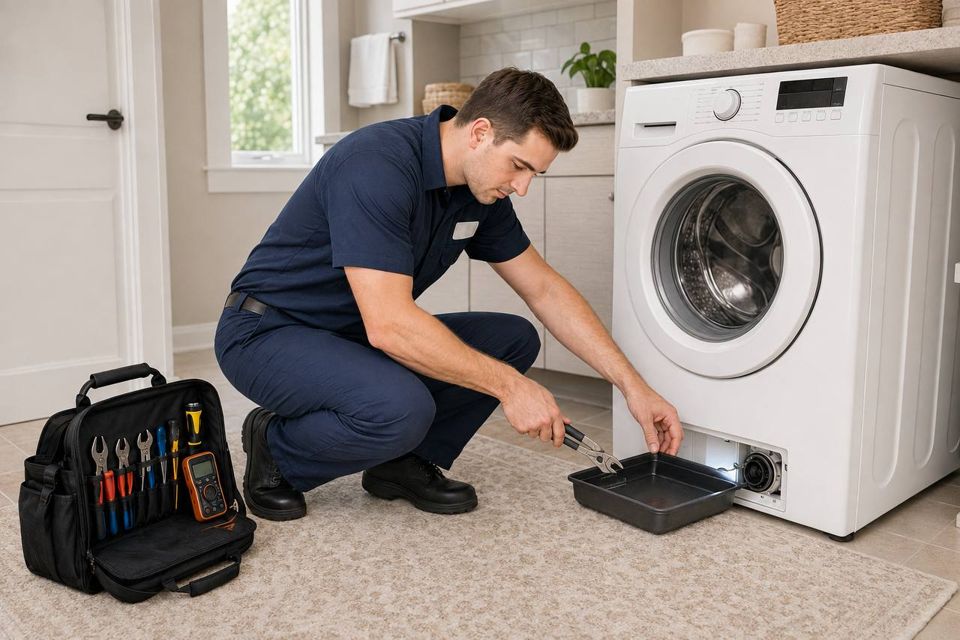
Puddles, new noises, or a cycle that dies at the same minute every load — nearly every washer complaint falls into one of those three bins, and each bin has its own suspects.
ZIP 98403 / 98407All makes & agesLog with every visit
North End washers sit in basements, on back porches, in Point Ruston closets and in university rental units, and each location fails its own way. The basement machines in Stadium and North Slope houses drain into a laundry sink or a floor drain that predates them; the condo machines stack in a closet cut to the inch; the rental machines simply work harder than anyone planned.
The intake call sorts the complaint into fill, wash, drain or spin, and the sweep tests that stage with the cabinet open. On the North End leg it adds one reading the century houses demand: supply voltage under load, because a modern washer’s board on an old shared circuit throws codes that look like a failing control and are not.
Washer Repair on the North End leg
Before you book
Clothes soaked after a finished cycle
Dispenser drawer backing up
Lid or door lock refusing to release
Puddle forming during fill or drain
Our 1910 house makes the fridge act strangely. Old circuits under modern load, most likely. Supply voltage gets measured before any board is suspected, and the readings go to your electrician if the wiring owns it.
The neighborhood’s share
Basement Drains, Old Circuits, and the Landlord’s Log
A basement washer in a 1910s house typically drains into a utility sink or a floor drain that a modern pump can outrun, and the resulting puddle looks exactly like a machine leak. The sweep runs a watched drain before anything on the washer is blamed, checks the sink trap and the standpipe height, and names the plumbing fix in the log when that is the honest answer. Old supply valves get exercised during the same visit; a washer that cannot be isolated in a century basement is a flood waiting for a long weekend.
The university rental blocks and the 6th Avenue side run washers that see three households’ worth of laundry a week. Bearings, boots, lid switches and pumps wear on a compressed schedule, and an owner needs a plain answer about whether the machine is worth the next repair. Owen writes the landlord’s log for that decision — what was measured, what was replaced, what the unit is worth — in language a tenant can read without a translation, and turns the visit around on the same leg so the unit is not down for a week.
Also on this leg. Point Ruston’s stacked pairs and compact European front-loaders get furniture-grade handling in kitchens and closets with no room to spare; the truck carries the stacking gear, and a path cleared to the closet is all the household needs to arrange.
Three questions
Washer Repair in North End — Asked Often
Water on the basement floor near our old washer.
The sink, floor drain or standpipe outrun by the pump is the first suspect in a century basement. A watched drain cycle settles it before any part is named.
Our rental’s washer is on its third repair. Keep it?
The log answers that in ink — measured findings, the figure, and a keep-or-retire verdict you can forward to the tenant as-is.
Stacked washer in a Point Ruston closet, no room to move.
Routine. The stacking hardware comes along for exactly that; clear a path to the closet door and the rest is simple.
Phone, ZIP, address, machine and the symptom. Owen rings back with a window that holds.
From the keeper’s log
Compartment temperatures, both sides, before opinionsMonitored cycle, fill to drainStacked pairs separated with the right gearCalibrated probe against the control’s beliefDrum hardware replaced as a set